January 2026 Update
A Thought on the Memory and Discourse of RAF Bomber Command during the Second World War

An additional note: I should add that I began writing this for publication in November but after suffering for over a week with food poisoning after holidaying in Mexico I fell with a fever a week later then had a chest infection that turned into pneumonia. To top this off I also had a tooth abscess so fell behind quite a lot with work as well as the blog. I am much better now, though still have something of a cough, and slowly catching up with everything. But anyway, here is the November blog now finished:
Whenever I am asked to describe my PhD thesis, I say that it as a cultural historical study of the British collective memory of the RAF in the Second World War. I start (roughly) from 1940 and end on the eightieth anniversary in 2020 (again roughly). I describe it as a continuation to Martin Francis’ excellent book The Flyer: British Culture and the Royal Air Force, 1939-1945. If you haven’t read it and have an interest in this topic (which I imagine you do if you are reading this) I highly recommend it. Francis concludes his work that “the flyers story is…very much Britain’s story, in the century of total warfare.”[1] I agree with this (I won’t give too much away and suggest you go off and read Francis’ work). I hope to understand this story more in relation to Britain’s identity from the period of the war itself to 2020. Within this, and what Francis does not cover, is an ever changing understanding and interpretation of the narrative of the RAF during the Second World War which I find fascinating. I promise to explain more of this later.
So, when people ask me about my thesis and I tell them they often respond with something along the lines of “Oh memory, so that’s studying veteran accounts then?” Well… yes and no. They are a part of it, but collective and cultural memory are both something rather different. So, I reply that though my thesis does look at veteran accounts, such as interviews and memoirs, it is more about a shared ‘memory’ which for the majority is not a ‘lived’ one. In the same way if I mention any historical event we have a narrative that’s shared and one we can recall. It’s not our memory directly but it is a memory we share as a collective, usually as a group like a nation. The topics of collective and cultural memories have certainly been a topic that has grown in academic writings. One such work, which is excellent by the way, is British Cultural Memory and the Second World War, edited by Julliette Pattinson and Lucy Noakes (who is incidentally my PhD supervisor – and no, I’m not just describing it as brilliant because she’s my supervisor – it’s such an important study). The work highlights well Britain’s collective interest in the war and attempts to understand shifts towards the study of Britain’s cultural history and collected memory of the war. The work is now over a decade old but still raises excellent points and the interest in cultural history as well as collective memory which has appeared to have grown since within wider history studies.[2]
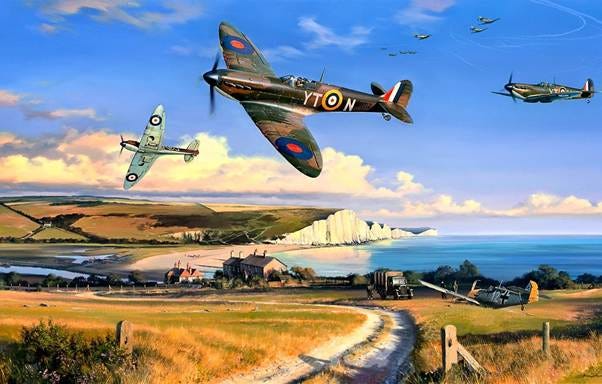
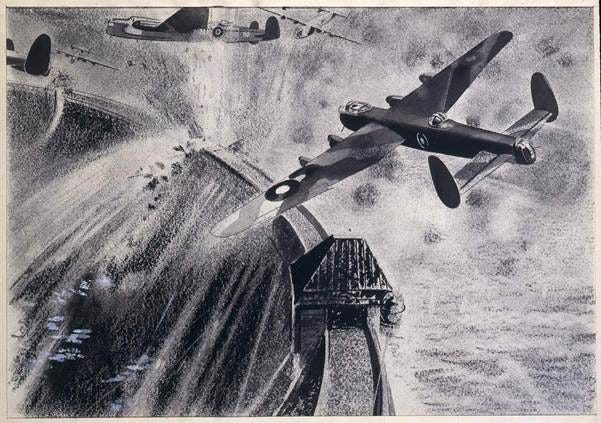
So how might I be using this in my work on the RAF and the Second World War? Well some questions could include “why is the narrative, and symbolism, of the Battle of Britain dominated by Spitfires when aircraft like the Hurricane played a huge (and I believe more prominent and import) role in the battle?” or perhaps “Why does operation chastise (a.k.a “The Dams Raid” on the night of the 16th /17th May 1943) get ‘remembered’ more than other operations?” Unpicking this begins by looking at culture which would include the influence of films which would form part of the answer to both of these questions. There are other factors too like ‘selective memory’ which could be conscious or subconscious. The Spitfire was a design of modernity and looks and sounds damn amazing (more so than the Hurricane many would argue) and it had a longer service in the RAF with more surviving examples. There are many other points to discuss here but hopefully this give you an idea about what, why, and how my thesis works.
As many of you may know, I co-host a podcast called Never Mind the Dam Busters, which in many ways is about the collective memory of RAF Bomber Command and re-evaluating this looking at perhaps less familiar narratives and topics. It would be hard to argue against the fact that the predominant collective memory of RAF Bomber Command is its role in the Second World War and if we single one event out it would, to mention it again, be the dams raid but also the raids on Dresden in February 1945. These are both a prevailing ‘popular’ and collective memory of the topic. There are reasons for these dominating narratives but perhaps the labelling of either raid on the side of two separate arguments of collective memory is, I would argue, the main reason for the prevailing interest and focus on these two events. That of a “good” and “bad” war fought by RAF Bomber Command.
The Dams Raid was a precision attack and is perhaps often used to highlight a narrative that Bomber Command fought an important war at high cost that included ‘clean raids’ (i.e. it was against a specific target and not one that was directly targeted at killing large numbers of non-combatants – though it did still achieve that). The Dams were inanimate objects and, in the film that perpetuates the legend, you don’t see the destruction in great detail on the ground when they are burst (spoiler alert there). Neither was it the intention to kill German civilians but instead to cause mass damage that would have a major effect on German war production. The Dams were a target because of their use in hydroelectric power and pure water production for German industry, most notably steel production. The film highlights this and it was a very important target that had been identified even before the war began. This was part of an oversimplified ‘good war’ narrative that is often perpetuated in popular culture.
The raids on Dresden on the other hand represents the facelessness of modern warfare and mass killing of Bomber Command’s ‘bad war.’ In narratives of this raid the suffering on the ground and mass firestorm and high casualty figures have been highlighted and sometimes exaggerated to make a point of the colossal destructive capabilities of the RAF’s bomber force. Add to this political drama such as Churchill washing his hands of the Command shortly afterwards, and narratives regarding a snubbing of the bomber crews through a lack of national memorials and wider recognition after 1945 creates a very emotive narrative. Of course, the truth is much more nuanced, but often history is rarely given that luxury in popular narratives and thus the resulting collective and cultural memories. Myths can then perpetuate and, in this case, on these two frequently oversimplified and emotive narratives.
An example of the two separate interpretations comes with two fairly recent publications. Dan Ellin, himself a regular guest on the podcast and chief archivist for the International Bomber Command Centre (IBCC) Digital Archive, recently reviewed two new books. These were The Greatest Force: How Bomber Command rose to become the No 1 factor in the destruction of Germany in WW2 (I’m not a fan of this title or the use of ‘WW2’) by Marcus Gibson and Daniel Knowles’ work (incidentally also a former guest on the podcast) Reaping the Whirlwind and it is evident that alternating views on Bomber Command’s role in the Second World War is still evident. Ellin highlights this well in a review of both books he wrote last year for From Balloons to Drones. Ellin notes how Knowles “engages with the complexity and the nuance of evolving attitudes to the bombing war in the context of changing politics and worldwide events over the last eight decades”. Yet for Gibson the work “tries so hard to clear the name of Bomber Command that he avoids the complexity of the subject and includes so much that is irrelevant.” One work, to paraphrase, is stuck in discussions of the 1990’s and early 2000’s whilst the latter incorporates the cultural and collective academic framework that has arisen since that time.[3] Clearly the discussions are still divided along with the collective memory with past arguments still rearing their head.
So, a question then rises: How the memory of RAF Bomber Command might change and what might be the influences on this as we near ever closer to the centenary of the Second World War? Hopefully my PhD thesis will attempt to tackle this but there is still a lot to discuss. The direct memory of the war is also fading fast. I’ve been subscribed to the International Bomber Command Centre’s (IBCC) newsletter for many years now. At the end of the newsletter there is a list of veterans that have passed away since the publication of the last newsletter. The list is growing smaller gradually each time and it’s evident that, sadly, with passage of time the living memory of these events will soon pass fully into history. Yet the interest in the Second World War, including that of Bomber Command, is still strong. Just walk into any history section of a bookshop to see the wealth of Second World War books or see how many films there on streaming sites compared to other wars or even perhaps search for Second World War games online. All are teeming with them. Clearly, we are still fascinated by it and in many ways still making sense of it. I don’t feel that this will be going away any time soon and there is one reason, of many, that I feel is coming to fruition.
In recent years the children of veterans have begun publishing books about their parents. Sometimes these are published diaries or otherwise a narrative written by their sons or daughters based on their research into their parents (usually fathers). For Bomber Command aircrew we have some excellent books that include the diaries of former Blenheim pilot Alistair Panton’s in Six Weeks of Blenheim Summer which includes a forward by his daughter Victoria and the story of the discovery of the story and want to publish the diary. In my own research on the raid on Augsburg during April 1942 I have recently read Gerald’s Sherwood’s book Bomber Pilot: From the Battle of Britain to the Augsburg Raid: The Unique Story of Wing Commander J S Sherwood DSO, DFC* about his father John. There has also been John Garwell’s Letter’s from Stalag Luft: A Tale of Two Heroes about John’s father Arthur. Each of these have added sources and information previously unavailable as well as highlighting some incredible stories.
On our pod (Never Mind the Dam Busters – just to plug it again there), we have had guests discuss books they have written about their relatives on a number of occasions. These have included Graham Waterton who discussed the incredible story of Brian Slade in The RAF’s Youngest Bomber Pilot of WW2: The Story of Flight Lieutenant Brian Slade DFC, Lancaster Pilot and Pathfinder. There has also been Marc Stevens who discussed the story of Peter Stevens, A German-Jewish refugee who flew with Bomber Command in Escape, Evasion and Revenge: German, Jewish, RAF Bomber Pilot and Great Escape. Finally, we also hosted Adam Hart who wrote about his great grandfather Frank Griffiths who flew Halifax bombers and undertook an incredible escape story in Operation Pimento: My Great-Grandfather’s Great Escape.
These stories have also been accompanied by personal stories of discovery. Some knew their relatives and others didn’t. Some had a blank page to start from while others had some sources to go on, such as logbooks or a few letters, but little else. In every these examples we have covered, they have been written after the subject has died. Possibly this comes as the writers themselves grow older and are perhaps near or passed retirement and they want to learn more about their families and share the incredible stories they find. Adam Hart was an exception to this as he was in his late teens and early twenties when undertaking the research and publication of his Great-Grandfather’s story. It would be wonderful if his work, which I have no doubt will, inspire other younger writers to research and perhaps write about their own relative’s war stories.
The prevailing thing though is that we are still fascinated, and perhaps haunted, by the Second World War and are still making sense of it. The Second World War was a seismic moment in history which again is itself worthy of numerous PhD theses and books for many years to come. Globally, politically, socially, and culturally we are all still feeling it’s affects over 80 years later. Many of us still have families ties and links to it that have, or will soon be, fading from living memory. The historical arguments such as those by Gibson and Knowles demonstrate that wider discussions on RAF Bomber Command are still prevalent and generate great interest but the rise in books like Bomber Pilot and Six Week’s of Blenheim Summer, also demonstrate a want of personal understanding and of its continuing emotional connection over 80 years on.
This blog hasn’t included in detail the many other films besides The Dam Busters, but neither TV productions, documentaries, videos games, and other elements that continue to influence the collective and cultural memory of the Second World War in popular and public discourse (and therefore winder memory). These means reach a larger audience than most (if not perhaps all) history books will ever hope to achieve to reach. We’re a society and culture of the digital age and many learn, experience, and discover history through these means more often than through books. Just look at the downloads of Call of Duty: WW2 (over 19 million and counting) compared to history book sales of 2017.[4] In top spot for new Second World War books sold in 2017, though it is difficult to find an exact figure, is Max Hastings’ All Hell let Loose which is estimated to have sold “multi-million” copies – but almost certainly nowhere near 17 million.
We therefore have to take these more popular media means of consuming history very seriously. Through things such as video games, films, and TV we are often making sense of how that collective cultural memory continues and forms popular narratives. This is what my thesis will examine as we move ever close to the centenary of the war in relation to the RAF and the Second World War. It will be a sharp focus on collective memories that include cultural, social, and national elements (and more!) and how these relate to Britain. The story of the Second World War still attracts great interest in Britain (and elsewhere too!) and even today is a subject of great discussion and evaluation. It is emotive and still very powerful. This interest clearly doesn’t seem to be ending any time soon – and nor should it, there’s still so much to discuss.
Sources used:
Written works:
· British Cultural Memory and the Second World War, ed. by Lucy Noakes and Julliette Pattinson (Bloomsbury 2014)
· Sherwood, Gerald, Bomber Pilot: From the Battle of Britain to the Augsburg Raid: The Unique Story of Wing Commander J S Sherwood DSO, DFC*
· Panton, Alistair, Six Weeks of Blenheim Summer
· Stevens, Marc, Operation Pimento: My Great-Grandfather’s Great Escape.
· Waterton, Graham, The RAF’s Youngest Bomber Pilot of WW2: The Story of Flight Lieutenant Brian Slade DFC, Lancaster Pilot and Pathfinder
Websites:
· ‘#ReviewArticle – Bomber Command at War’ by Dr. Dan Ellin, , from From Balloons to Drones, https://balloonstodrones.com/2025/09/16/reviewarticle-bomber-command-at-war/#_ftn1
· Harper Collins ‘All Hell Let Loose’ https://harpercollins.co.uk/products/all-hell-let-loose-the-world-at-war-1939-1945-max-hastings?variant=40035367649358 [accessed 19th January 2026]
[1] Martin Francis, The Flyer: British Culture and the Royal Air Force, 1939-1945 (Oxford: 2008) pp.203
[2] British Cultural Memory and the Second World War, ed. by Lucy Noakes and Julliette Pattinson (Bloomsbury 2014)
[3] Dan Ellin, ‘#ReviewArticle – Bomber Command at War’, From Balloons to Drones, https://balloonstodrones.com/2025/09/16/reviewarticle-bomber-command-at-war/#_ftn1 [accessed 7th November 2025]
[4] Harper Collins ‘All Hell Let Loose’ https://harpercollins.co.uk/products/all-hell-let-loose-the-world-at-war-1939-1945-max-hastings?variant=40035367649358 [accessed 19th January 2026]
Very good James and made me think. I’ve got in trouble with some of the IC when I suggested that maybe the time has come to have a thorough analysis of the strategic bombing campaign. And one can do that without casting slurs on the crews. I can’t speak to BC memory culture however I have read quite a bit about the German memory of the SWW. How that has developed and changed since May ‘45. What and how they remember the events. How geography impacts upon it. How those memories have been and continue to be politically exploited. How new historical research forces them to confront difficult truths. I’ll stop because undoubtedly you have a better grasp of this and I do.